2024 · Undergraduate
 Central University of TechnologyBachelor's Degree
Faculty of Engineering, Built Environment and Information Technology
Bachelor of Quantity Surveying develops knowledge and practical capability in engineering design, scientific analysis and technology-based problem-solving. Students build analytical, communication and problem-solving skills through theory and applied learning. Exact modules and practical components vary by institution and study year.
Mathematics; engineering sciences; design; technical drawing or modelling; computing; laboratories; projects; and discipline-specific engineering practice. Module names and sequencing must be confirmed in the institution's current curriculum.
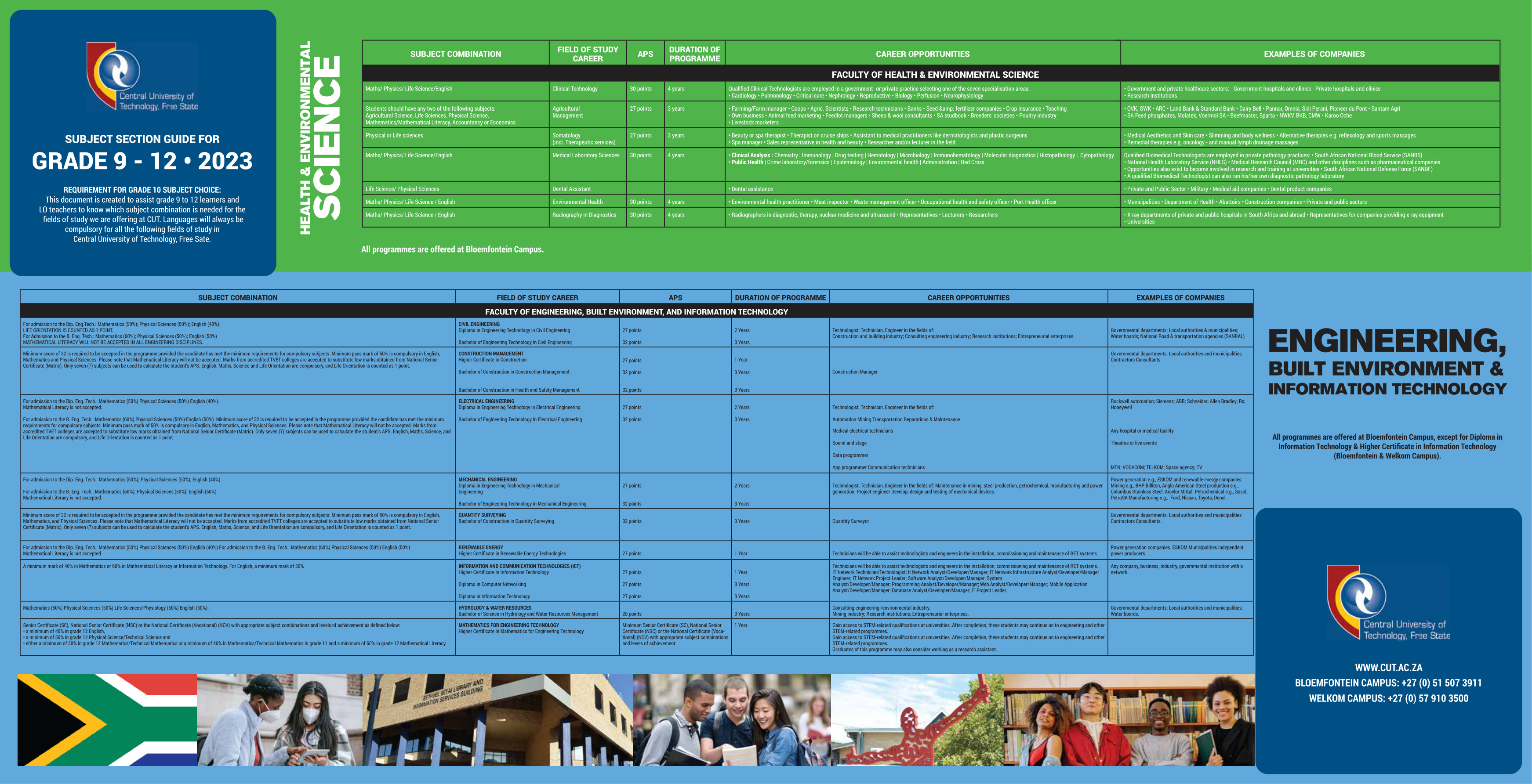
For candidates who matriculated in 2007 or before: Candidates who matriculated in 2007 or before must have obtained at least a minimum of 50% on Standard Grade or 40% on Higher Grade in Mathematics, or Candidates who matriculated from 2008
onwards must have a National Senior Certificate (NSC) with a minimum score of 32 or more points on the CUT scoring scale in the Grade 12 examination and must have obtained at least a minimum of 60-69% in English and Mathematics, and Physical
Science. For candidates who completed the NSC in 2008 and thereafter: The minimum entry requirement is the Senior Certificate (before 2008); National Senior Certificate or the National Certificate (Vocational) (from 2008) with appropriate
subject combinations and levels of achievement, as defined in the Government Gazette, Vol. 751, No 32131 of 11 July 2008, and in the Government Gazette, Vol. 533, No. 32743, November 2009. Alternatively, a Higher Certificate or an Advanced
Certificate or Diploma in a cognate field may satisfy the minimum admission requirements. English, Mathematics, and Physical Science are required at minimum NQF level 4. Career Opportunities Employment opportunities for graduates of the
programme exist in built environment. These include building construction, building maintenance, building restoration and asset management. Graduates may become part of a design or development team, be self-employed or act as consultants to the
construction industry. Graduates may choose varying and challenging careers across a range of sectors including: Quantity surveying consultancies. Financial Institutions Construction and specialist trade companies. Design and build companies
Buildings renovation and restoration companies. Property developers and consortia. Local authorities and regulatory bodies. National departments and implementing agencies. State Owned Enterprises. Property management companies. 1 ST YEAR 2 ND
Graduates may apply for relevant honours or postgraduate diploma study where their qualification, modules and academic results meet the receiving programme's rules. Advanced or postgraduate study in the same engineering discipline, engineering management or a related specialisation, subject to academic results and professional requirements.
Engineering technologist; design engineer; project technician; production specialist; consulting professional; or technical manager, depending on the discipline and professional registration.
Open a campus to view its map, directions and other linked courses.
Open a prospectus in EduCoast’s internal viewer. Downloads require sign-in.