2024 · Undergraduate
 Central University of TechnologyBachelor's Degree
Faculty of Health and Environmental Sciences
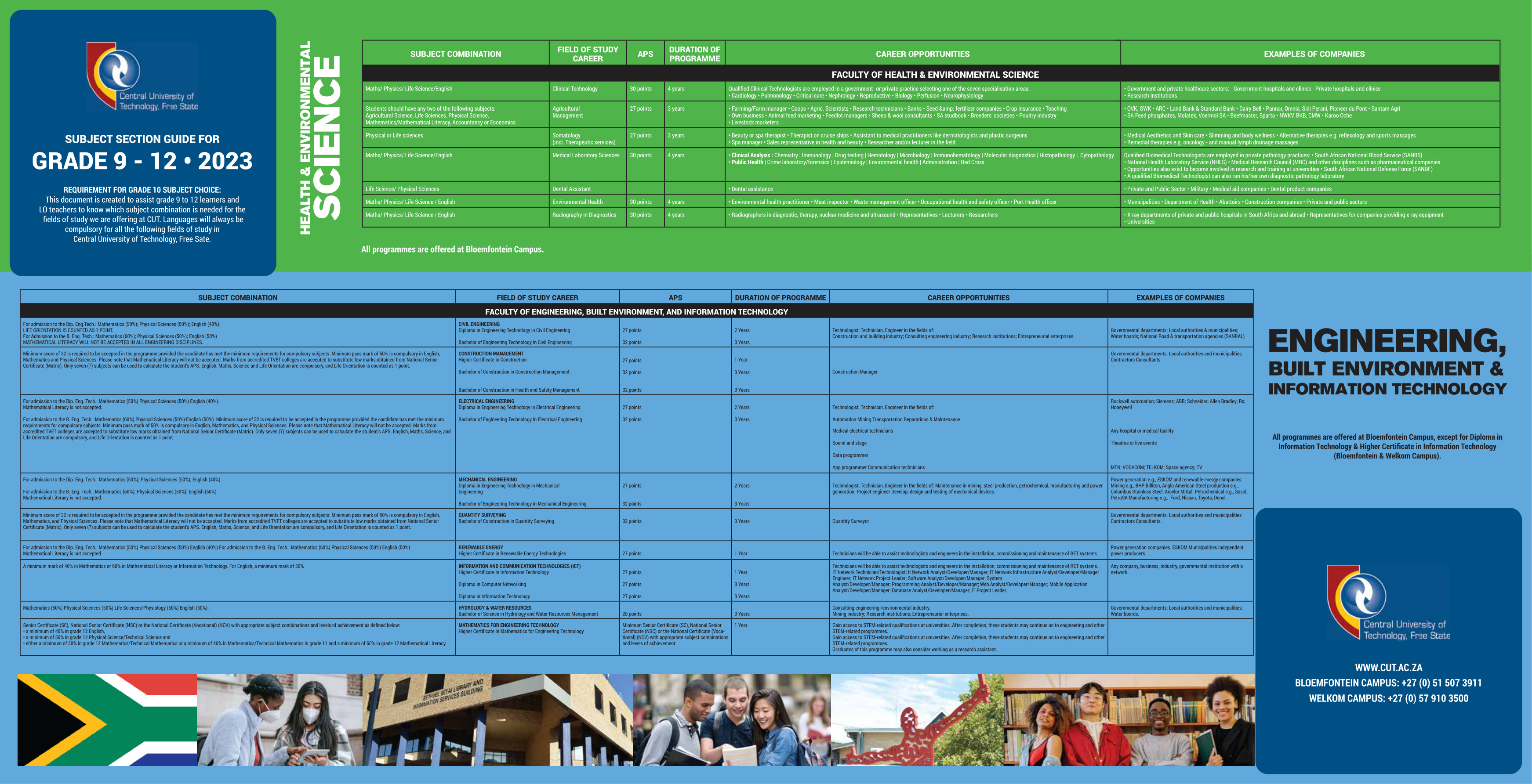
Bachelor of Health Science: Medical Laboratory Sciences develops knowledge and practical capability in human health, clinical knowledge and evidence-based patient care. Students build analytical, communication and problem-solving skills through theory and applied learning. Exact modules and practical components vary by institution and study year.
Biomedical sciences; professional practice; ethics; communication; clinical or laboratory skills; supervised practical learning; and discipline-specific health sciences. Module names and sequencing must be confirmed in the institution's current curriculum.
A National Senior Certificate or equivalent qualification. A minimum of 30 points on the CUT scoring scale. Applicants with an M-score of 35 and above will be admitted directly into the programme. Applicants with an M-score of 30 – 34 will be
referred for psychometric evaluation, whereafter the programme selector(s) will decide as to selection. All applicants are subject to a selection process for admission into the programme, and are required to submit proof of job shadowing at a
diagnostic laboratory. For candidates who matriculated in 2007 or before: In addition to the general admission requirements, a minimum mark of 60% on standard grade or 50% on higher grade in the following subjects: English, Biology/Physiology,
Physical Sciences and Mathematics. For candidates who matriculated in 2008 and thereafter: In addition to the general CUT admission requirements, a minimum pass mark of 3 (40 – 49%) in Life Orientation and 4 (50 – 59%) in Mathematics, Life
Sciences, English and Physical Sciences is required. Applicants must have an NCS with endorsement for a bachelor’s degree. Applicants in possession of a National Certificate Vocational (NCV) will be selected according to the selection
requirements as approved by Senate. Prerequisites A student must pass 50% of the first-year instructional offerings in order to continue with the second-year instructional offerings; 50% of the second-year instructional offerings in order to
continue with the third-year instructional offerings; and 50% of the third-year instructional offerings in order to continue with the fourth-year instructional offerings. Students are required to pass 100% (i.e. all) of the fourth-year
instructional offerings. On completion of this qualification, a graduate wanting to practice as a medical laboratory scientist will be required to register with the HPCSA after which they may work in government, private and research health care
Graduates may apply for relevant honours or postgraduate diploma study where their qualification, modules and academic results meet the receiving programme's rules. Relevant honours, postgraduate diploma, clinical specialisation, master's or research study, subject to professional and institutional admission rules.
Roles in clinical practice, community health, laboratories, rehabilitation, health services or research, depending on the qualification and required professional registration.
Open a campus to view its map, directions and other linked courses.
Open a prospectus in EduCoast’s internal viewer. Downloads require sign-in.